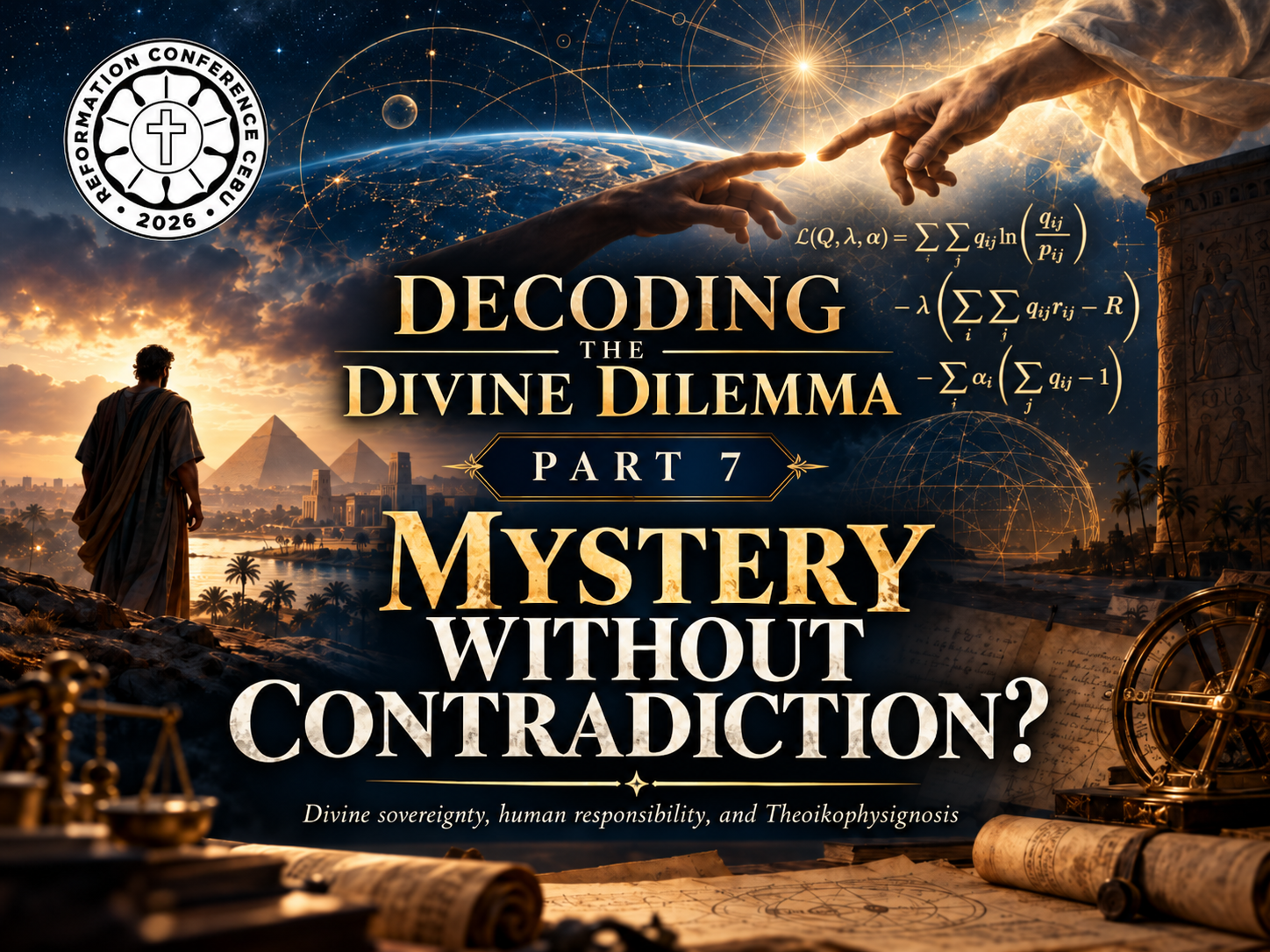
Part 7: Mystery Without Contradiction?
We began this series in Part 1 with a question that has occupied Christians for centuries: If God is sovereign over all things, are human beings really responsible for what they do?
Six articles later, the question has not disappeared. But perhaps we can now see it more clearly.
In Part 2, Joseph gave us the biblical tension in one remarkable sentence:
“As for you, you meant evil against me, but God meant it for good.”
— Genesis 50:20
One event. Two intentions. The brothers acted wickedly and willingly. God acted wisely and providentially. Human responsibility was not erased by divine sovereignty, and divine sovereignty was not suspended in order to preserve human responsibility.
In Part 3, we asked what kind of God governs history. Scripture presents Him as omniscient, omnipotent, holy, wise, good, immutable, and transcendent. He is not simply another agent within creation competing with us for control.
Then, in Part 4, we encountered the Reformed distinction between primary and secondary causation.
God is the primary cause—the Creator, Sustainer, and sovereign Governor of all things. Human beings remain genuine secondary causes—thinking, intending, deliberating, choosing, acting, and bearing moral responsibility.
The Westminster Confession captures this balance when it affirms that God orders events according to the nature of secondary causes, whether “necessarily, freely, or contingently.” That means Reformed theology does not preserve God’s sovereignty by turning human beings into puppets. Nor does it preserve human agency by creating a realm of independence outside providence. Both truths are affirmed.
One Reality, Different Levels
Part 5 then asked whether part of our difficulty comes from forcing different explanations onto the same plane.
A human action may be described morally, psychologically, historically, biologically, socially, or even probabilistically. Those descriptions need not be enemies.
Likewise, a theological description of an event does not necessarily compete with a creaturely description of the same event.
The question is not simply: Did God cause this, or did the human being cause this? Perhaps the better question is: In what sense, and at what level, are we speaking of causation? This does not solve providence. But it may help us avoid constructing a contradiction where Scripture gives us a mystery.
Scripture and Nature
In Part 6, we finally introduced Theoikophysignosis.
Its starting point is distinctly Reformed. The Belgic Confession speaks of creation as being before our eyes “like a beautiful book,” while Scripture gives us clearer and fuller knowledge of God. The Book of Nature and the Book of Scripture ultimately have the same Author. But they do not have the same function.
Scripture remains the norming authority. Nature may illuminate. It may provide analogies. It may reveal patterns. It may help us ask better questions. But creation does not sit in judgment over revelation. This is where Theoikophysignosis enters the discussion. It asks whether insights drawn from philosophy, cognition, probability, mathematics, and carefully bounded scientific analogies might help us visualize or conceptualize relationships already affirmed in Scripture. Not prove them. Not replace them. Not explain God. But perhaps illuminate them.
And therefore several safeguards remain essential:
- Representation is not proof.
- Visibility is not demonstration.
- Integration is not validation.
- Model is not ontology.
These distinctions matter because no equation can contain God. No mathematical model can reproduce the eternal decree. No scientific theory can demonstrate divine concurrence. And no interdisciplinary framework should pretend to remove the mystery of providence.
Mystery Without Contradiction?
So where does that leave us? Perhaps here: Mystery does not necessarily mean contradiction.
The fact that we cannot exhaustively explain how God sovereignly governs human choices does not mean that Scripture has given us logically incompatible truths. Reformed theology has historically resisted the temptation to weaken either side. God remains fully sovereign. Human beings remain genuinely responsible. God’s decree is certain. Creaturely intentions remain real. Providence governs. Secondary causes truly operate.
And in the most striking example of all, the crucifixion itself was carried out according to God’s definite plan while those who committed the act remained morally accountable (Acts 2:23).
This is not a minor theological curiosity. It affects how we understand suffering, sin, prayer, obedience, providence, tragedy, repentance, and hope.
When Joseph looked back over betrayal, slavery, injustice, imprisonment, exaltation, famine, and reconciliation, he did not see a world in which either God acted or human beings acted. He saw both. And somehow, without excusing evil or diminishing responsibility, he could confess that the sovereign hand of God had never disappeared. That is the divine dilemma we have been decoding.
But this series has only opened the door. The fuller question remains: Can an interdisciplinary framework help us see how divine sovereignty and meaningful human agency may coexist coherently without reducing mystery to mechanism, confusing a model with reality, or allowing interdisciplinary insights to displace the authority of Scripture?
That is the journey we will take in the breakout session:
DECODING THE DIVINE DILEMMA
An Interdisciplinary and Transdisciplinary Journey to Behold God’s Sovereignty and Human Freedom through Theoikophysignosis
At Reformation Conference Cebu 2026, we will move beyond the overview and examine the framework more closely, its theological foundations, the Joseph case study, the relationship between primary and secondary causation, different levels of description, interdisciplinary analogies, conceptual modeling, and the safeguards necessary to keep the entire exercise subordinate to biblical and Reformed theology.
The purpose is not to eliminate mystery. It is to ask whether we can behold it more clearly without mistaking mystery for contradiction.
Come and decode the divine dilemma with us.
Leave a Reply