Part 5: What If We Are Looking at the Same Reality from Different Levels?
In Part 4, we asked whether God and human beings should really be imagined as competing causes. Reformed theology answers no.
God is the primary cause, sovereignly sustaining and governing all things, while human beings remain genuine secondary causes who think, desire, deliberate, choose, act, and bear moral responsibility. But this leads us to another question: Could the same event be truthfully described at more than one level without those descriptions cancelling one another?
Consider an ordinary human decision:
We can describe it morally: Was the action righteous or sinful?
We can describe it psychologically: What desires, fears, memories, or motivations influenced the person?
We can describe it historically: What circumstances brought the person to that moment?
We might even describe aspects of it biologically or probabilistically: What processes, constraints, possibilities, and pathways were involved?
These descriptions need not contradict one another. They may simply answer different questions about the same reality. Now return once more to Joseph. His brothers’ betrayal can be described from the human level: jealousy, resentment, deliberation, deception, violence, and genuine moral guilt.
Yet Joseph gives another description of the same history:
“As for you, you meant evil against me, but God meant it for good.”
— Genesis 50:20
The event is one. The intentions are different. The levels of agency are different. And yet both descriptions are true.
The Reformers and Providence
This way of thinking is not foreign to Reformation theology.
Calvin, especially in his treatment of providence in the Institutes, argued that God is not a distant spectator merely watching history unfold. God actively and wisely governs His creation, while the wickedness of sinful actions properly belongs to the sinful creature rather than to God.
Peter Martyr Vermigli develops the point with particular clarity. In his treatment of providence, he describes providence as God’s ordering of things toward their proper ends and insists that created things retain their own natures and properties under that providence. He maintains the genuine role of secondary causes even while placing them entirely within God’s sovereign government. In Vermigli’s thought, something can therefore be necessary with respect to divine providence while still being contingent with respect to its proximate creaturely causes. Ad Fontes
That distinction is remarkably relevant to our dilemma.
God’s sovereignty does not require the erasure of the created order. Rather, the activity of creatures remains real precisely within the order God sustains.
Zacharias Ursinus makes a similarly striking point in his Commentary on the Heidelberg Catechism. He reasons that because God is the first cause, all secondary causes depend upon Him. Yet he explicitly rejects the idea that this renders creaturely means useless. God not only ordains the ends He intends to accomplish; He also ordains the means and secondary causes through which those ends are reached. Ursinus even observes that the same effect may be called necessary in relation to the unchangeable first cause and contingent in relation to a changeable secondary cause. Reformed Confessions
That is a profound distinction. One event can be considered in relation to God’s unchangeable providence and also in relation to genuine creaturely causation without requiring us to deny either.
Heinrich Bullinger presses the same truth pastorally. In The Decades, he argues that providence does not abolish ordinary means, human labor, responsibility, or the proper order of things. God works through those means. Significantly for our discussion, Bullinger points directly to Joseph: God can turn evil human purposes toward good ends while the evil itself still arises from human corruption and sin.
The later Reformed confessions preserve this theological grammar with remarkable precision.
The Westminster Confession of Faith 5.2 states:
“Although, in relation to the foreknowledge and decree of God, the first Cause, all things come to pass immutably, and infallibly; yet, by the same providence, he ordereth them to fall out, according to the nature of second causes, either necessarily, freely, or contingently.”
Notice what the confession does not say. It does not say that because God is the first Cause, secondary causes become illusions.Quite the opposite. God’s providence orders events to occur according to the nature of secondary causes. The sovereignty of God therefore does not require the destruction of creaturely reality.
This reflects the biblical Creator-creature distinction. God is not simply one more causal agent inhabiting the universe alongside us. Paul declares:
“In him we live and move and have our being.”
— Acts 17:28
Our existence and action depend upon God, yet we truly exist and truly act.
One Reality, More Than One Description?
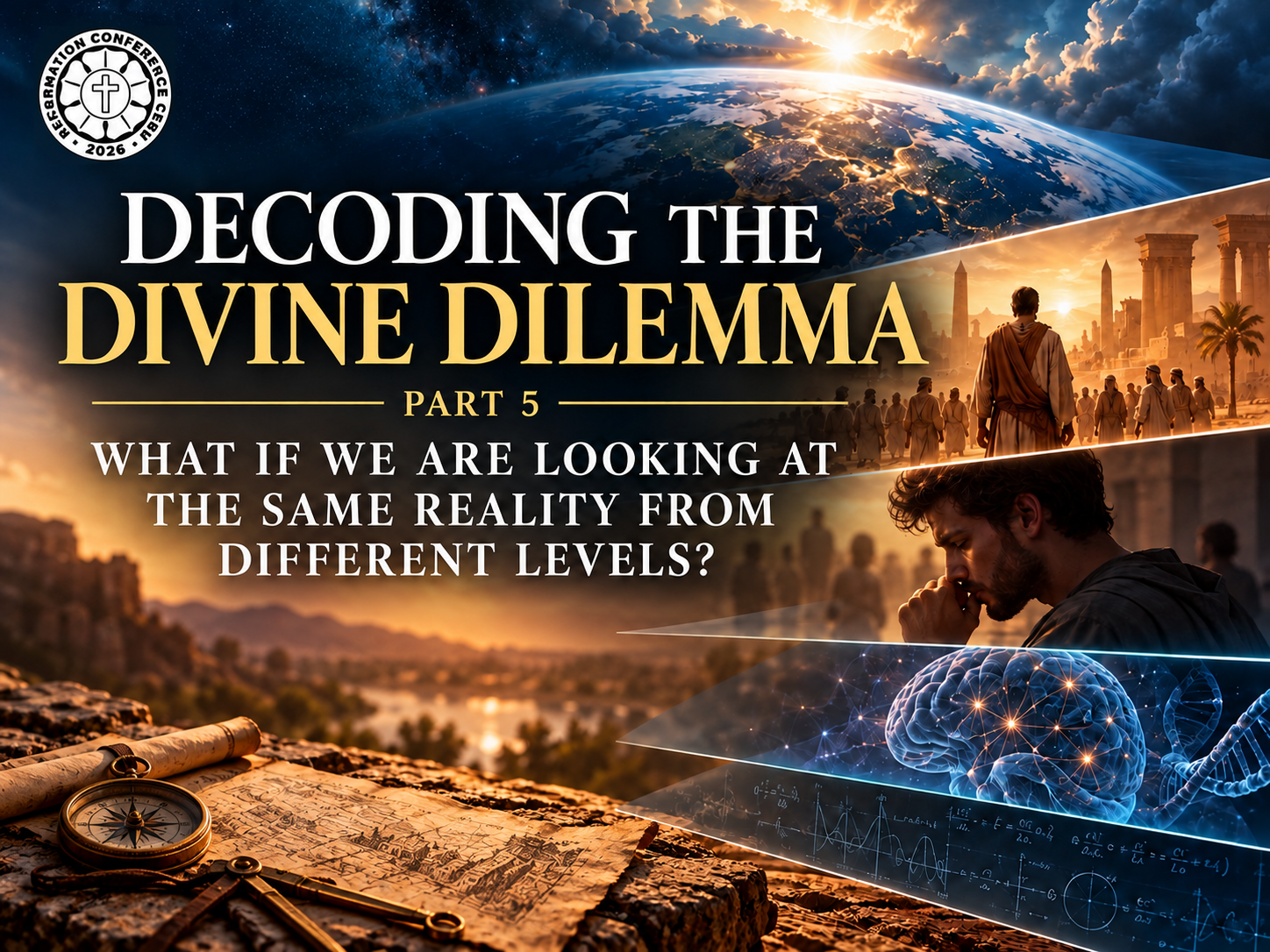
This raises an intriguing possibility. Perhaps part of the sovereignty-responsibility dilemma arises because we sometimes force explanations belonging to different levels into direct competition. A human action can be described theologically, morally, psychologically, historically, biologically, and perhaps even mathematically without assuming that one description must eliminate all the others.
The Scottish physicist, neuroscientist, and Christian polymath Donald MacKay explored related questions at the interface of science, human agency, and Christian faith. His work raises the possibility that the same reality may admit different but compatible descriptions without one necessarily cancelling the other.
That does not prove divine providence. Nor does it explain God. But it may offer an analogy worth considering. What if some of the apparent contradiction between divine sovereignty and human responsibility arises because we are forcing explanations from different levels into direct competition? What if theological description and creaturely description can both be genuinely meaningful without collapsing into one another?
Here we must proceed carefully.
An analogy is not a proof.
A scientific description does not demonstrate divine providence.
A mathematical model does not reveal the inner workings of the divine decree.
And no interdisciplinary framework is permitted to sit in judgment over Scripture.
Yet what if insights from different fields can help us see more clearly a relationship Scripture already requires us to affirm?
That question brings us directly to the doorstep of Theoikophysignosis.
We have encountered the biblical dilemma. We have examined Joseph. We have considered the attributes of the God who governs history. We have distinguished primary and secondary causation. And now we have begun to ask whether reality itself may be intelligible at different levels of description. The pieces are beginning to come together. But the framework itself still needs to be introduced.
Next: Part 6 — Theoikophysignosis: A Framework for Seeing the Problem Differently
—————————————————————————————––
The relationship between God’s sovereignty and human responsibility is not merely a theological puzzle to be discussed, it touches the very way we understand providence, choice, accountability, suffering, and the unfolding of our lives before God.
If this short article has stirred in you a desire to explore more deeply how divine sovereignty, human agency, concurrence, and secondary causation may be understood together, continue the journey with us at Reformation Conference Cebu 2026. When selecting your breakout session, choose: DECODING THE DIVINE DILEMMA
Explore how the Reformed doctrine of providence and divine concurrence provides the theological foundation for thinking about God as the primary cause while human beings remain genuine secondary causes and morally responsible agents. The session will also introduce Theoikophysignosis as an interdisciplinary framework for illuminating this enduring theological tension without reducing mystery to mechanism, or allowing interdisciplinary models to displace the authority and priority of biblical theology.
Continue the Journey at Reformation Conference Cebu 2026
𝐁𝐄𝐇𝐎𝐋𝐃 𝐎𝐔𝐑 𝐆𝐎𝐃 𝟐𝟎𝟐𝟔
October 21–23, 2026
Hosted by Bradford United Church of Christ, Inc.
𝗥𝗘𝗚𝗜𝗦𝗧𝗘𝗥 𝗛𝗘𝗥𝗘:
https://forms.gle/fzGFvqpBn2ceztfs9
𝗥𝗘𝗚𝗨𝗟𝗔𝗥 𝗥𝗔𝗧𝗘:
Php 1,000.00
September 1–October 15
Registration is inclusive of the conference kit only. Food and accommodation are not included.
Come and behold the glory of our ever-present God through the faithful proclamation of His Word, Christ-centered worship, and fellowship with His Church.
Leave a Reply