Many people struggle with the idea of an angry God, especially those who have experienced the destructive and painful effects of sinful human anger. For many, the word wrath carries a negative connotation. Webster’s Dictionary defines wrath as “strong vengeful anger or indignation,” or “retributive punishment for an offense or a crime.”
Both humans and God express wrath. But God’s wrath and man’s wrath differ greatly. God’s wrath is holy, righteous, and always justified; human wrath, because of sin, is often self-centered, distorted, and unjustified. Human anger often seeks revenge. God’s wrath seeks justice. God’s wrath is His holy and righteous opposition to ungodliness and unrighteousness (Rom. 1:18), expressed in His just judgment against human rebellion. In other words, God’s wrath represents His fundamental opposition to evil.
The Protestant Reformer John Calvin understood this well. In his Institutes of the Christian Religion, he reminds us that God, as a just judge, cannot allow His law to be violated without judgment (Book II, Chapter 16, Section 1). Divine wrath, therefore, is not an uncontrolled outburst of anger but an expression of God’s perfect holiness and justice.
Still, someone may ask, “How can a loving God be an angry God?” I struggled with that question too. I never fully understood or appreciated divine wrath until I sat down with a rape victim and listened to her story. As I heard the atrocities committed against her, I was repulsed by the evil she had suffered. I found myself praying, not merely for the victim’s comfort, but for God’s justice and wrath to come upon the perpetrator.
In that moment, I began to see something I had previously struggled to grasp: wrath is not the opposite of love but the righteous response of love toward what destroys and violates what God calls good. A God indifferent to evil would not be good. A God who never judges wickedness would not be just.
Yet this raises an even greater question: What happens when God’s righteous wrath is directed toward us, sinful people? This is where the glory of the gospel comes into view.
Calvin offers a profound insight into this apparent tension between divine love and wrath. He explains that God loved us even before we were reconciled to Him through Christ. It is because God first loved us that He provided the very means by which we could be reconciled to Him (Institutes, II.16.3–4). God’s love does not contradict His justice; rather, His love is revealed in providing the sacrifice that satisfies His justice.
This brings us to what Martin Luther called the theology of the cross. In his Heidelberg Disputation (1518), Luther emphasized that we come to understand God’s saving work through the suffering and cross of Christ. The cross reveals not only the seriousness of our sin but also the extraordinary grace of God toward sinners.
In this session, we will explore the central reality of divine wrath, the reason God’s wrath is necessary, and the biblical necessity of propitiation, the satisfaction of God’s righteous wrath through Christ’s sacrificial death. We will consider how Christ, in His substitutionary death, willingly bore the judgment our sins deserved and satisfied divine justice.
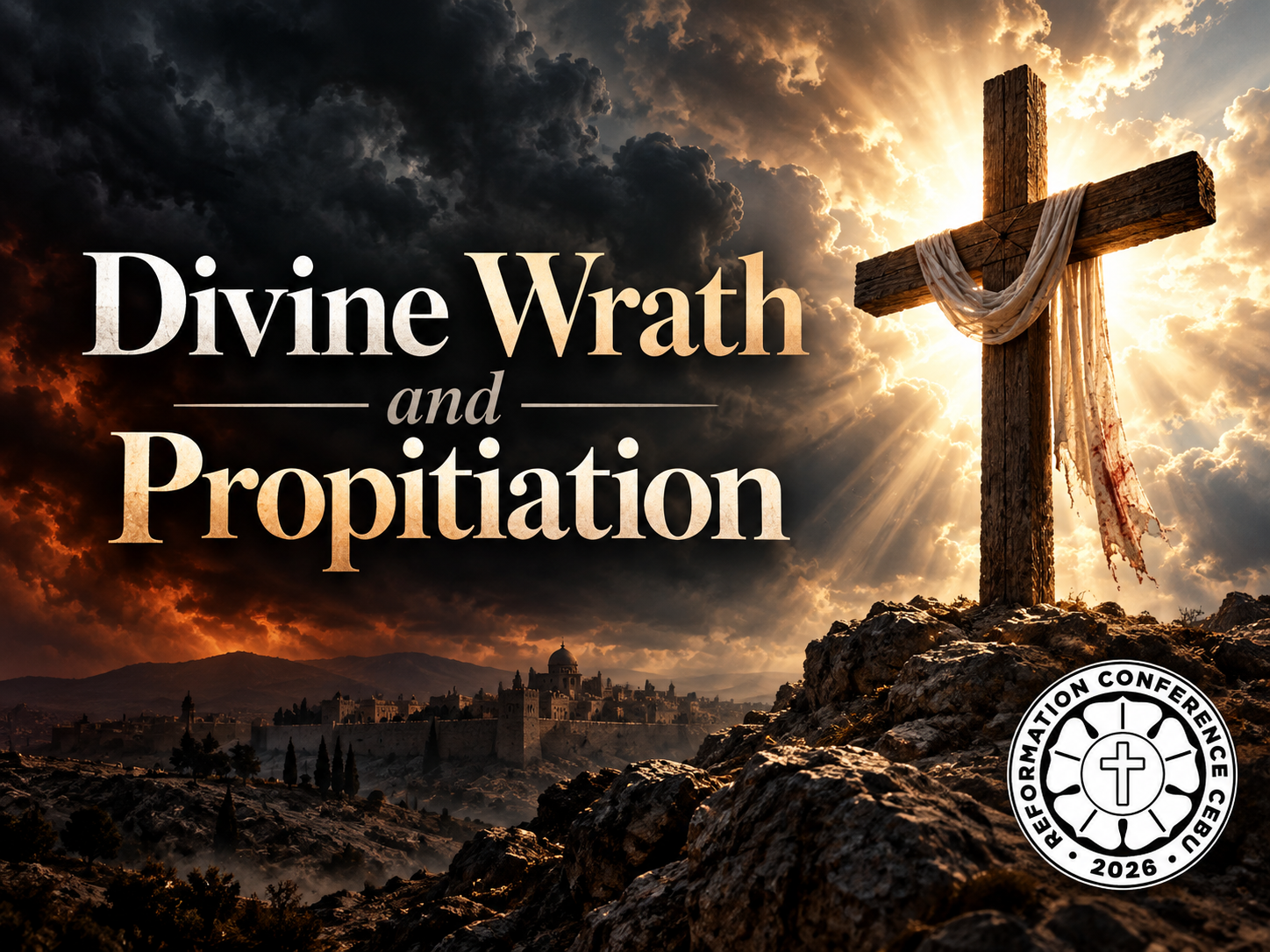
At the cross, we discover that God’s wrath is not the end of the story. In love, God provided His Son, who bore our judgment and turned away the wrath that stood against us. The cross is where holy wrath and amazing grace meet.
The reality of God’s wrath is not merely a theological doctrine to be discussed; it confronts us with profound questions about God’s holiness, justice, love, and our own sinful condition before Him. How can a loving God also be a God of wrath? Why must sin be judged? And how does the cross of Christ reveal both the righteousness of God’s judgment and the greatness of His grace?
If this short article has stirred in you a desire to explore more deeply the nature of divine wrath, the necessity of God’s justice, and the glorious truth of propitiation, continue the journey with us at Reformation Conference Cebu 2026. When selecting your breakout session, choose: DIVINE WRATH AND PROPITIATION.
Explore how Scripture, understood through the rich theological heritage of the Protestant Reformation, reveals God’s righteous opposition to sin and the necessity of Christ’s substitutionary sacrifice. Drawing from the insights of Reformers such as John Calvin and Martin Luther, the session will examine how Christ willingly bore the judgment sinners deserved, satisfying divine justice and turning away God’s righteous wrath. Discover why the cross is not where God’s love overcomes His justice, but where His perfect justice is satisfied through the sacrifice of His Son, whom He graciously provided in love.
Continue the Journey at Reformation Conference Cebu 2026
𝐁𝐄𝐇𝐎𝐋𝐃 𝐎𝐔𝐑 𝐆𝐎𝐃 𝟐𝟎𝟐𝟔
October 21–23, 2026
Hosted by Bradford United Church of Christ, Inc.
𝗥𝗘𝗚𝗜𝗦𝗧𝗘𝗥 𝗛𝗘𝗥𝗘:
https://forms.gle/fzGFvqpBn2ceztfs9
𝗥𝗘𝗚𝗨𝗟𝗔𝗥 𝗥𝗔𝗧𝗘:
Php 1,000.00
September 1–October 15, 2026
Registration is inclusive of the conference kit only. Food and accommodation are not included.
Come and behold the glory of our holy, righteous, and loving God through the faithful proclamation of His Word, Christ-centered worship, and fellowship with His Church. Together, let us marvel at the cross, where holy wrath and amazing grace meet.