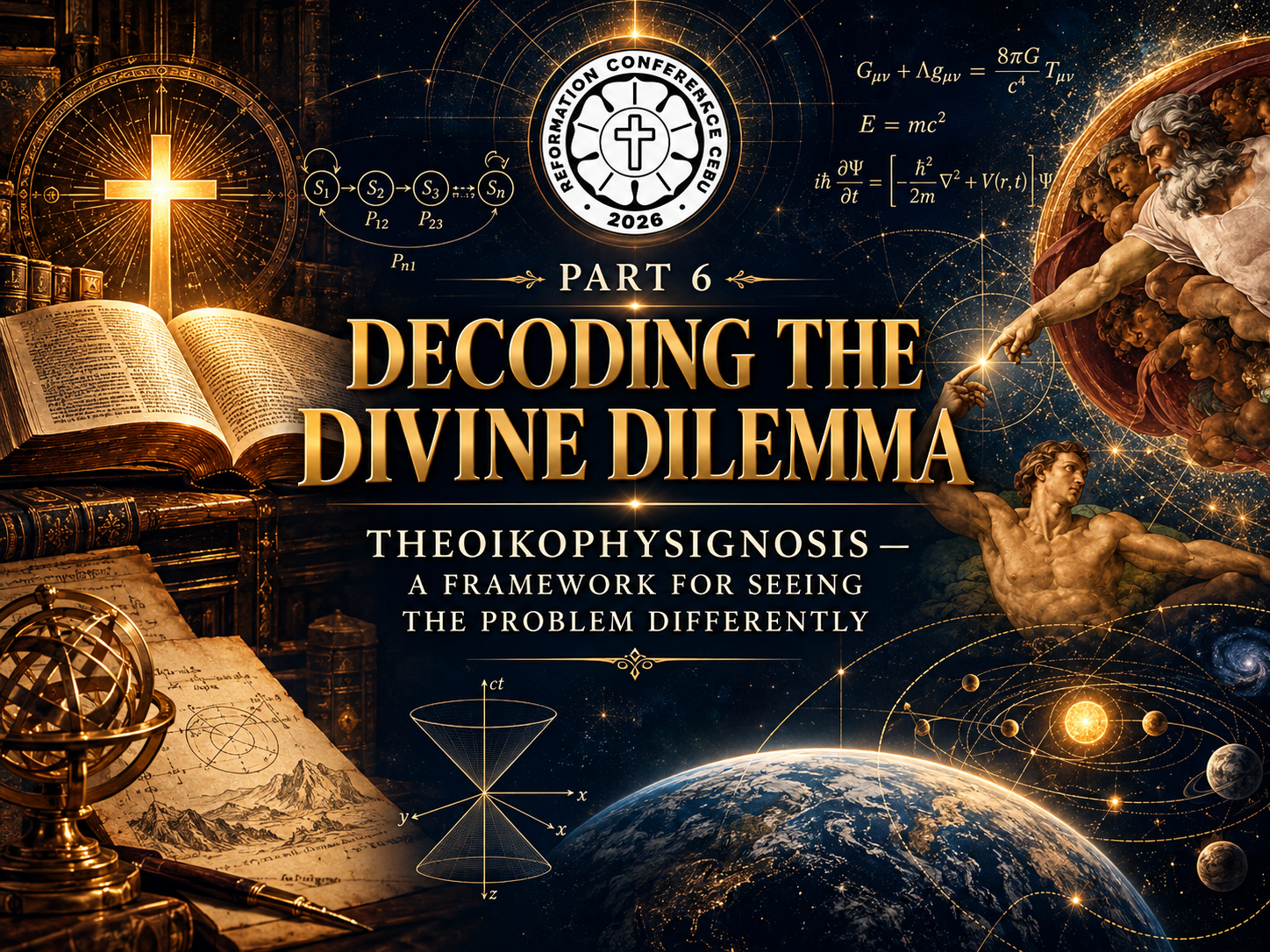
Part 6: Theoikophysignosis — A Framework for Seeing the Problem Differently
In Part 5, we asked whether the same reality can be truthfully described from different levels without those descriptions cancelling one another.
A human act may be described morally, psychologically, historically, biologically, and even probabilistically. Yet none of these descriptions necessarily exhausts the event. And when Scripture speaks of providence, it introduces another level altogether. Joseph’s brothers acted from jealousy and hatred. God acted in wisdom and providence.
One event. Different intentions. Different kinds of agency. That brings us at last to the framework behind this series: Theoikophysignosis.
The term may sound unfamiliar, but its basic aim is simple. Theoikophysignosis is an interdisciplinary and transdisciplinary framework developed to explore how truths revealed in Scripture may be illuminated carefully and analogically through insights drawn from other fields of inquiry. Its purpose is not to explain God away. It is not an attempt to reduce providence to mathematics, psychology, physics, cognition, or probability. And it is certainly not an effort to place human reasoning above Scripture.
The Two Books: Scripture and Nature
Here the older Reformed language of the “two books” becomes especially helpful. The Reformers and the Reformed confessional tradition often spoke of God making Himself known through what might be called the Book of Scripture and the Book of Nature.
The Belgic Confession, Article 2, expresses this beautifully. We know God first through the creation, preservation, and government of the universe, which it describes as being before our eyes “like a beautiful book.” We know Him even more clearly and fully through His holy and divine Word.
That order matters. Nature speaks truly, but Scripture speaks more clearly. Creation reveals, but Scripture interprets authoritatively. General revelation is real, but it never becomes an independent judge over special revelation.
Psalm 19 captures both realities in one song:
“The heavens declare the glory of God, and the sky above proclaims his handiwork.”
Yet that same psalm turns immediately to the perfection of the law of the LORD.
Romans 1:20 likewise teaches that God’s invisible attributes are perceived through the things that have been made.
The world, therefore, is not theologically silent. But neither is it self-interpreting. This is precisely where Theoikophysignosis locates itself. It begins with the Book of Scripture as the norming authority, and then asks whether the Book of Nature may provide analogies, patterns, structures, and relationships that help us think more carefully about what Scripture already teaches. The direction is crucial: Scripture does not need nature to become true. Rather, nature may help us behold, illustrate, or conceptualize truths Scripture has already given us.
This is why Theoikophysignosis looks at fields such as human cognition, causation, probability, decision-making, philosophy, and selected features of the natural sciences. Not because they can prove divine providence. Not because mathematics can penetrate the eternal decree. Not because physics can explain God. But because creation itself may contain structures that analogically illuminate the coherence of truths revealed by its Creator.
A Framework with Boundaries
The Reformers would also have warned us against speculation detached from the Word. Calvin repeatedly cautioned Christians against trying to penetrate the hidden counsel of God beyond what He has revealed. There is a proper place for inquiry but also a proper place for humility. Theoikophysignosis therefore operates with several safeguards:
- Representation is not proof. A model may represent a relationship without demonstrating that reality exhaustively.
- Visibility is not demonstration. Seeing a pattern in creation does not prove a theological doctrine.
- Integration is not validation. Bringing theology into conversation with another discipline does not mean that discipline validates Scripture. And perhaps most importantly:
- Model is not ontology. A conceptual or mathematical model is not the reality itself.
These boundaries matter because the divine dilemma is not a mechanical problem waiting to be solved by a sufficiently clever equation. God cannot be placed inside a model. The divine decree cannot be plotted as another variable. Providence is not a hidden physical force waiting to be measured.
So why use a framework at all? Because models and analogies can sometimes help us see relationships more clearly. A map is not the territory, but a good map can help us understand the terrain.
Likewise, if both the Book of Scripture and the Book of Nature come from the same God, then carefully examining creation may help us recognize patterns that make certain theological relationships more intelligible, provided Scripture remains the governing norm. This brings us back to the central question of the series. If God is the primary cause, and human beings are genuine secondary causes, must one explanation eliminate the other? Or might both be true without contradiction because they belong to different levels of causation and description?
Theoikophysignosis does not claim to remove the mystery. It does not claim to demonstrate the mechanics of providence. Rather, it asks whether the mystery may be coherent without being reducible. The goal is not to make God comprehensible. The goal is to ask whether Scripture’s affirmation of both divine sovereignty and meaningful human responsibility can be illuminated without weakening either truth. We have now encountered the biblical dilemma. We have examined Joseph. We have considered the attributes of the God who governs history. We have distinguished primary and secondary causation. We have explored different levels of description. And now we have opened both books, the Book of Scripture and the Book of Nature while insisting that Scripture remains the final norm by which our interpretations must be judged.
The pieces are almost in place. There remains one final question: Can they be brought together without explaining away the mystery?
Next: Part 7 — Decoding the Divine Dilemma: Mystery Without Contradiction?
—————————————————————————————––
The relationship between God’s sovereignty and human responsibility is not merely a theological puzzle to be discussed, it touches the very way we understand providence, choice, accountability, suffering, and the unfolding of our lives before God.
If this short article has stirred in you a desire to explore more deeply how divine sovereignty, human agency, concurrence, and secondary causation may be understood together, continue the journey with us at Reformation Conference Cebu 2026. When selecting your breakout session, choose: DECODING THE DIVINE DILEMMA
Explore how the Reformed doctrine of providence and divine concurrence provides the theological foundation for thinking about God as the primary cause while human beings remain genuine secondary causes and morally responsible agents. The session will also introduce Theoikophysignosis as an interdisciplinary framework for illuminating this enduring theological tension without reducing mystery to mechanism, or allowing interdisciplinary models to displace the authority and priority of biblical theology.
Continue the Journey at Reformation Conference Cebu 2026
𝐁𝐄𝐇𝐎𝐋𝐃 𝐎𝐔𝐑 𝐆𝐎𝐃 𝟐𝟎𝟐𝟔
October 21–23, 2026
Hosted by Bradford United Church of Christ, Inc.
𝗥𝗘𝗚𝗜𝗦𝗧𝗘𝗥 𝗛𝗘𝗥𝗘:
https://forms.gle/fzGFvqpBn2ceztfs9
𝗥𝗘𝗚𝗨𝗟𝗔𝗥 𝗥𝗔𝗧𝗘:
Php 1,000.00
September 1–October 15
Registration is inclusive of the conference kit only. Food and accommodation are not included.
Come and behold the glory of our ever-present God through the faithful proclamation of His Word, Christ-centered worship, and fellowship with His Church.