Reformation Conference Cebu logo RefCon Cebu

Tag: Protestant Reformation

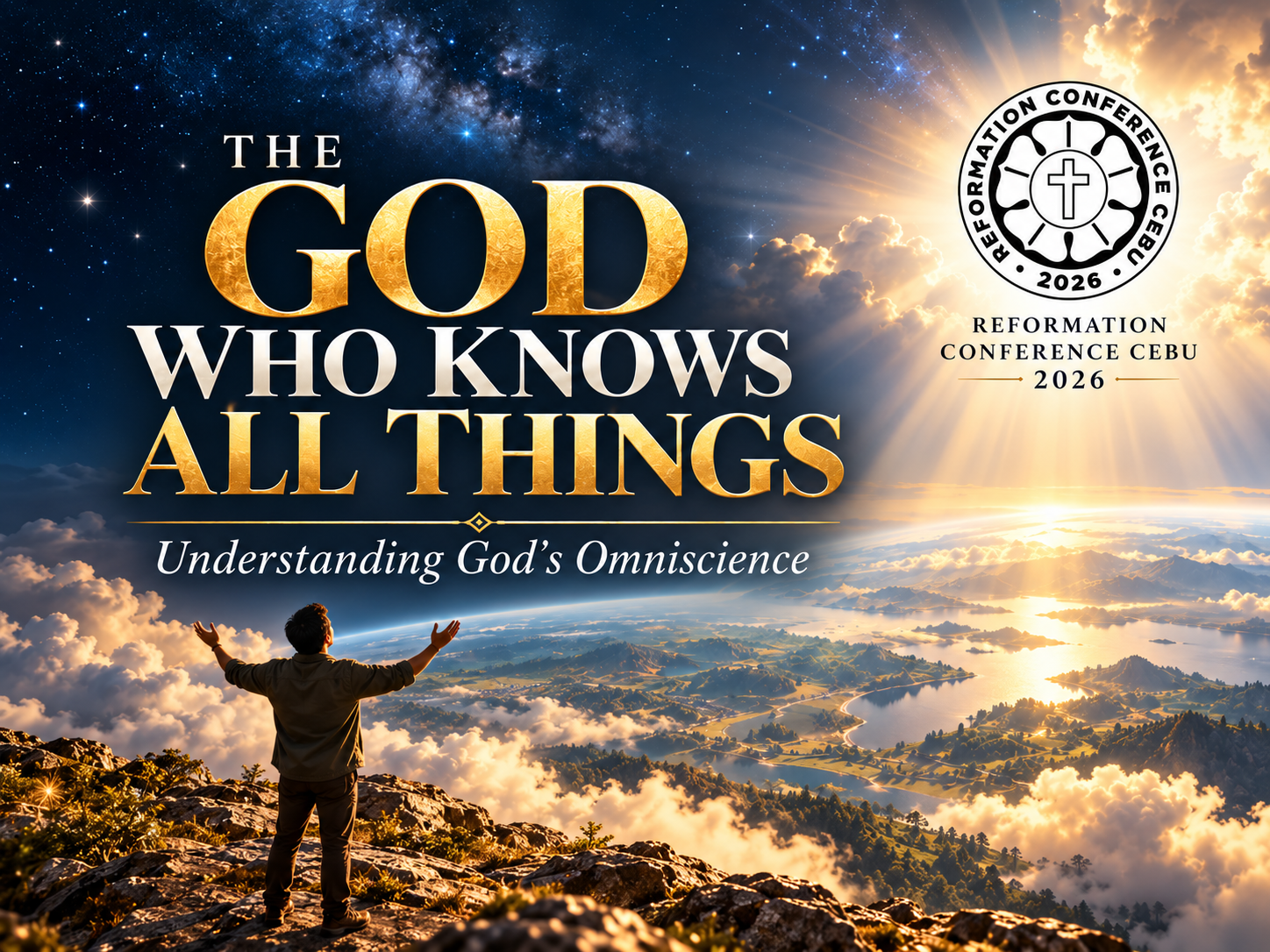
  • The God Who Knows All Things: Understanding God’s Omniscience – (Breakout Session overview)

    The God Who Knows All Things: Understanding God’s Omniscience – (Breakout Session overview)

    Have you ever wondered, “Is there anything about me that God does not know?”

    He knows our thoughts before we speak, our struggles that no one else sees, our failures we try to hide, and even the desires deep within our hearts. Nothing is hidden from His sight, nothing escapes His knowledge, and nothing ever surprises Him.

    God’s omniscience means that He knows all things perfectly, eternally, and without limitation. He does not learn, discover, or gain new information. His knowledge is infinite and infallible. As Psalm 139 teaches, God knows our thoughts, words, actions, and hearts completely: “Even before a word is on my tongue, behold, O LORD, you know it altogether” (Psalm 139:4).

    This is also why the Reformed tradition has always connected God’s perfect knowledge with His sovereign rule over all things. God does not simply look ahead through history and discover what will happen. He knows the end from the beginning because all things stand before Him and unfold according to His eternal wisdom and purpose.

    John Calvin strongly rejected the idea that God merely watches history from a distance. Speaking of divine providence, Calvin wrote that “nothing happens but what he has knowingly and willingly decreed.” For Calvin, God’s knowledge is not the passive observation of a distant spectator. The God who perfectly knows His creation is also the God who wisely and sovereignly governs it.

    This truth reminds us of God’s infinite wisdom and sovereignty, teaching us to trust Him even when we cannot understand our circumstances. What is confusing to us is never confusing to God. What appears unexpected to us has never taken Him by surprise. As creatures, our knowledge is limited, fragmented, and dependent. God’s knowledge is perfect, eternal, and independent.

    This should humble us.

    We cannot hide our sins behind appearances, excuses, or carefully constructed images of ourselves. Hebrews 4:13 reminds us that “nothing in creation is hidden from his sight.” God sees us as we truly are. His omniscience therefore calls us to live with humility, holiness, repentance, and integrity before Him.

    Yet God’s perfect knowledge is not only a reason for reverence. For those who belong to Christ, it is also a profound source of comfort.

    The God who knows all things knows every sorrow we carry, every temptation we face, every prayer we struggle to express, and every burden that others may never see. He knows our weaknesses better than we know them ourselves. And still, according to His grace, He has set His love upon His people.

    The Reformers repeatedly directed troubled consciences away from confidence in themselves and toward the promises of God in Christ. Our comfort does not rest in how well we understand ourselves, how strongly we hold on to God, or how perfectly we can explain His purposes. Our comfort rests in the God who knows His own, keeps His promises, and accomplishes His saving purposes in Jesus Christ.

    Ultimately, God’s omniscience points us to Christ. The God who knows every hidden sin has provided the Savior who bears the guilt of His people. Through Christ, we do not need to flee from the all-knowing God; we may draw near to Him. In Christ, sinners are forgiven, reconciled, and welcomed into the presence of the very God before whom nothing is hidden.

    There is therefore something deeply comforting about being completely known by God.

    He knows the sins we confess.
    He knows the struggles we cannot explain.
    He knows the suffering no one else sees.
    He knows our beginning and our end.
    And He knows perfectly how His purposes will be accomplished.

    Because God knows us completely, we can live honestly before Him, trust His wisdom when we cannot understand His ways, and rest in His sovereign grace.

    The God who knows all things is the God who rules all things and, in Jesus Christ, He is the God in whom His people may confidently rest.


    The reality of God’s omniscience is not merely a theological doctrine to be discussed; it confronts us with profound questions about God’s infinite knowledge, wisdom, sovereignty, and our own lives before Him. What does it mean that God knows all things perfectly and eternally? Does God merely foresee what will happen, or is His perfect knowledge inseparably connected with His sovereign purposes? How should we live knowing that every thought, word, action, and even the deepest intentions of our hearts are fully known to Him? And how can this truth, which should fill us with reverence and humility, also become a source of profound comfort and assurance?

    If this short article has stirred in you a desire to explore more deeply the nature of God’s omniscience, His eternal and exhaustive knowledge of all things, and the relationship between His perfect knowledge, sovereign providence, and our daily lives, continue the journey with us at Reformation Conference Cebu 2026. When selecting your breakout session, choose: DIVINE OMNISCIENCE.

    Explore how Scripture, understood through the rich theological heritage of the Protestant Reformation, reveals the God whose knowledge is infinite, infallible, eternal, and independent of His creation. Drawing insights from the Scriptures and the reflection of the Reformers, the session will examine how God’s omniscience is inseparably connected with His wisdom, sovereignty, and providence. Discover why nothing surprises God, why nothing escapes His knowledge, and why His people can trust Him even when His purposes remain beyond their understanding. Above all, behold how the God who knows us completely, including our deepest sins and weaknesses, has graciously provided salvation and assurance through Jesus Christ. For those who belong to Christ, being fully known by God is not merely a reason for reverence, but a wonderful assurance of His unfailing love, wisdom, and faithfulness.

    Continue the Journey at Reformation Conference Cebu 2026

    𝐁𝐄𝐇𝐎𝐋𝐃 𝐎𝐔𝐑 𝐆𝐎𝐃 𝟐𝟎𝟐𝟔

    October 21–23, 2026

    Hosted by: Bradford United Church of Christ, Inc.

    𝗥𝗘𝗚𝗜𝗦𝗧𝗘𝗥 𝗛𝗘𝗥𝗘: https://forms.gle/fzGFvqpBn2ceztfs9

    𝗥𝗘𝗚𝗨𝗟𝗔𝗥 𝗥𝗔𝗧𝗘: Php 1,000.00**

    September 1–October 15, 2026

    *Registration is inclusive of the conference kit only. Food and accommodation are not included.*

    Come and behold the glory of our all-knowing, all-wise, and sovereign God through the faithful proclamation of His Word, Christ-centered worship, and fellowship with His Church. Together, let us marvel at the God from whom nothing is hidden, whose wisdom knows no limits, and whose perfect knowledge assures us that we are never forgotten, never beyond His care, and never outside His sovereign purposes.
  • Hammer & Nails

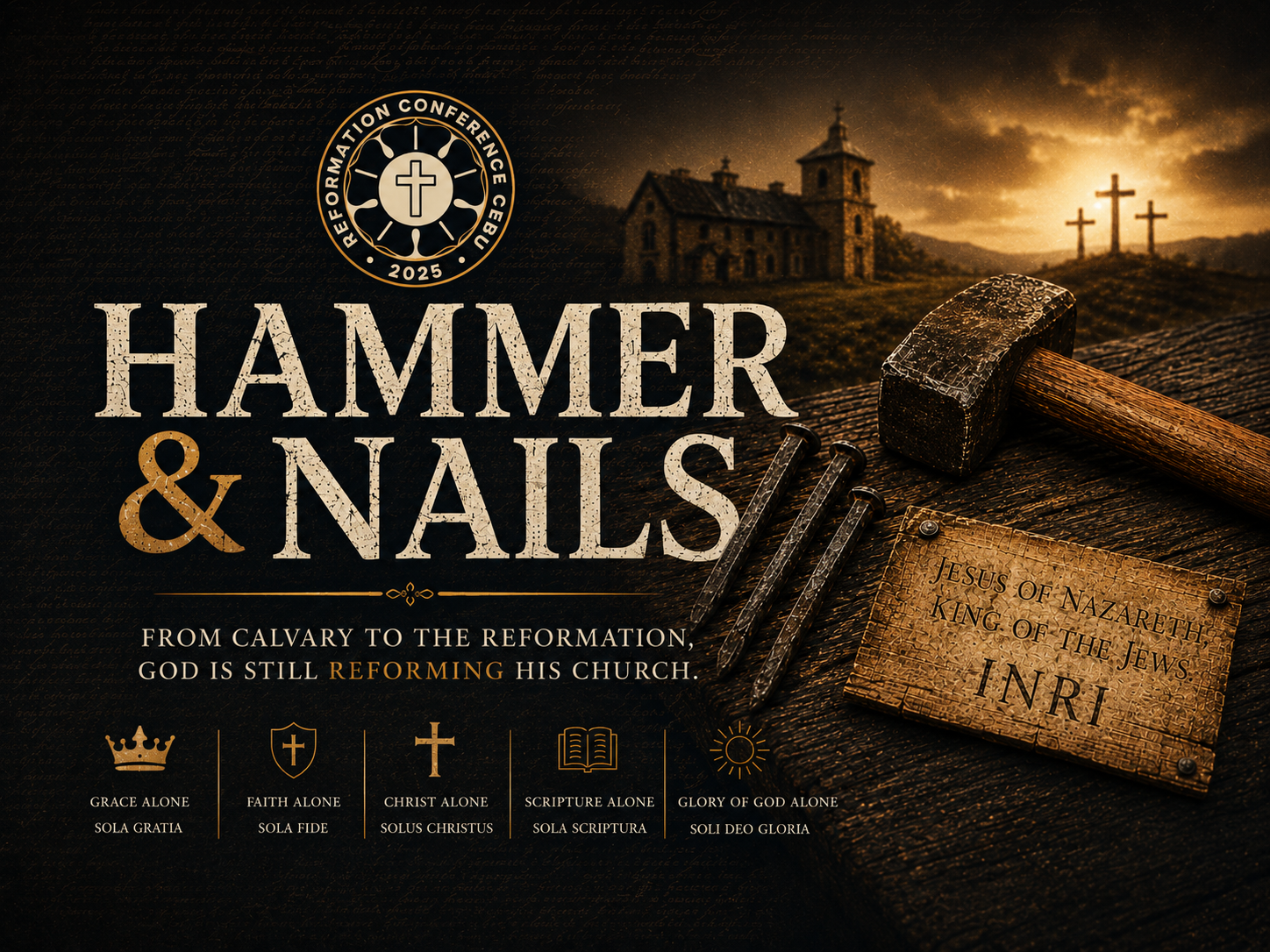
    Hammer & Nails

    Pilate had no idea that the ordinary instruments surrounding a Roman crucifixion, the hammer, the nails, and even the inscription placed above Jesus, would become enduring symbols associated with the most consequential death in human history.

    Above the crucified Christ, Pilate ordered an inscription identifying Him:

    Jesus of Nazareth, King of the Jews (INRI).

    The sign that was meant as an accusation became an unwitting declaration of His identity and Lordship. And beneath that sign, the King gave Himself for His people.

    The King has died in our place!

    Sixteen centuries later, another hammer and nails would become part of the traditional image of the Reformation, when Martin Luther posted his Ninety-Five Theses at Wittenberg on October 31, 1517. His goal was not to start a revolution against the Roman Catholic Church, but to call the church back to the truth.

    Just as the Roman inscription above Christ unintentionally proclaimed the King, Luther’s protest became one of the sparks of a Reformation that sought to reclaim the true Gospel secured by Christ’s victory. Its central theological convictions would later be summarized in what we now call the Five Solas:

    We are saved by Grace Alone (Sola Gratia), through Faith Alone (Sola Fide), in Christ Alone (Solus Christus), according to Scripture Alone (Sola Scriptura), all for the Glory of God Alone (Soli Deo Gloria).

    Different hammers. Different nails.

    Yet the same sovereign God who ruled over those events is still at work today through His providence.

    The impact of those hammer and nails reached my own life more than five hundred years later. And I never even thought that, by God’s providence, attending a Reformation Conference would catapult me into opportunities to preach His Word in places I had never imagined.

    In 2023, I missed attending Reformation Conference Cebu in person because, typical mistake, I forgot to file my work leave on time. So, I had to settle for watching the livestream from my screen while the speakers broke down the Five Solas.

    My former college classmate, Lenli, who happened to be at the host church, BUCCI, would send me photos from the event, which made me super eager to attend the conference someday.

    By 2025, God’s timing finally brought me to my first in-person Reformation Conference.

    The theme was Ecclesia Reformata, which translates to “The Church Reformed.”

    I remember being filled with so much excitement seeing all those passionate pastors and leaders come together, united by their love for Scripture.

    As our church’s former Youth President and current Youth Adviser, I have always had a heart for young people. I really wanted to make the most of the conference, not only to grow personally but also to bring what I learned back to our youth leaders.

    One of our primary goals this year is to establish biblical church discipline and membership within our youth group, Pure Heart Generation, and possibly extend it to the whole congregation, if the Lord wills and our church leadership agrees.

    And with that in mind, it was an easy choice for me to attend the breakout session on church membership led by Pastor Derick Parfan.

    But honestly speaking, I never expected my first Reformation Conference experience to be followed by such an arduous struggle.

    When I returned to my local church, I started to sense that not everyone understood what I had learned and brought home from the conference. Some responded with what I perceived as unfair judgment and criticism. My beliefs were questioned, my theological stances were challenged, and some of my views were misrepresented.

    I come from a Trinitarian Pentecostal-Charismatic church, and I understand that there is sometimes a lack of historical context when it comes to church history and the Reformation. I think many people in our congregation would be surprised to learn how deeply our Protestant and Evangelical heritage in the Philippines connects back to the Reformation and how much of the biblical teaching we inherited was shaped by it.

    It hurt because the misunderstandings came from people I considered my own church family.

    I’d be lying if I said there weren’t moments when I felt discouraged.

    But just as God used the ordinary means surrounding Christ’s crucifixion, and later used ordinary men and circumstances during the Reformation, He also used one of the ordinary tools of my generation, social media, to help me articulate convictions He had been shaping in my heart for such a long time.

    As soon as I started speaking more openly about my theological convictions on social media, things escalated quickly.

    I suddenly became the epicenter of controversy and misunderstanding within the congregation. Concerned that my views might challenge some of the church’s established doctrines, I was asked to step back from my teaching ministries, which I respectfully complied with.

    A series of meetings followed.

    Throughout those meetings, I began to notice a recurring pattern. It wasn’t simply that some of my views were being misunderstood, I also became increasingly concerned about the level of doctrinal discernment within the church.

    Teachings that sounded encouraging, familiar, or uplifting sometimes seemed to receive greater acceptance than teachings that demanded closer biblical examination. And I became increasingly concerned about the influence of teachings associated with the prosperity gospel, Word of Faith theology, and the New Apostolic Reformation.

    For me, the question increasingly became simple:

    What does Scripture actually say?

    It was exhausting, and for a time, I felt completely on my own.

    I had a few people who supported me, but I still longed for fellowship with others who shared these convictions. The constant friction made me resolve at one point that I would stop talking about these things altogether.

    But here I am, typing my thoughts anyway.

    One thing, however, became certain, I could not knowingly compromise what I had become convinced Scripture taught.

    Church history repeatedly shows that calls for biblical reform can produce deep conflict, especially when long-held teachings or practices are challenged by Scripture.

    From Peter Waldo and John Wycliffe to Jan Hus and Martin Luther, reform often came at tremendous personal cost.

    But I also understand this, opposition itself does not prove that I am right.

    I, too, must constantly test my convictions against the Word of God.

    That, after all, is part of what Sola Scriptura means.

    Scripture stands above the church, above traditions, above teachers, above movements, and above me.

    Truth must correct all of us.

    And where truth and error genuinely conflict, fidelity to Scripture must ultimately take precedence.

    I truly love my church.

    My church is where God led me to see the beauty of His Word. My church is where I spent most of my life as a Christian. These are people I have worshiped with, served with, prayed with, and grown with.

    That is precisely why all of this has been difficult.

    I had no plans to leave, and I still do not desire division for the sake of division. But I also understand where these convictions may ultimately lead if substantial doctrinal differences remain unresolved.

    A Christian cannot thrive indefinitely in poor soil.

    Unless a church is willing to continually listen, examine itself, and reform according to Scripture, there may eventually come a point when parting ways becomes unavoidable.

    Even now, I still pray with everything within me that we would all return again and again to Scripture and allow God’s Word to correct us, shape us, humble us, and reform us.

    Not simply that they would see what I see.

    But that we would all see what God has actually said.

    In the end, my discouragement did not stop me from making Christ known.

    The Lord was very gracious in giving me strength to stand on His Word while also guiding me toward fresh opportunities to preach His truth for His glory.

    After the Reformation Conference in 2025, by God’s providence, I was invited to speak to youth groups and churches across Leyte, first at King of Glory Church in Ormoc and Christ Alone Gospel Church in Baybay for their Christmas fellowships, then at our company Bible study group’s second anniversary, and eventually back to Leyte to preach again at a youth camp in Tabango.

    Even as I write this, the conviction is only growing stronger.

    There is an ongoing need for the church to be reformed, our understanding of God, His Word, our worship, and the way we live.

    And it must continually be reformed according to the Word of God.

    On the final day of the Reformation Conference last year, October 30, 2025, which happened to be my birthday, I woke up with one prayer in my heart:

    “O Mighty God, spark a reformation in every local church in Balamban, in Cebu, and in the whole Philippines. Let it spread like wildfire to every corner of the nation, that we may see the light of the Word again. Here we stand in this generation. Help us, God!”

    May God raise up a generation that stands for His truth in our time.

    And may He equip us with our modern-day hammer and nails, not to exalt ourselves, not merely to win theological arguments, but to keep bringing everything back under the authority of His Word.

    Ecclesia reformata, semper reformanda secundum Verbum Dei.

    The church reformed and always being reformed according to the Word of God.

    May we continually be reformed by the Word of Truth, our solid ground.


    Continue the Journey at Reformation Conference Cebu 2026

    If this reflection has stirred a desire for a deeper, more Christ-centered understanding of revival, the Church, and the glory of God, join us at:

    𝐁𝐄𝐇𝐎𝐋𝐃 𝐎𝐔𝐑 𝐆𝐎𝐃 𝟐𝟎𝟐𝟔

    October 21–23, 2026

    Hosted by Bradford United Church of Christ, Inc.

    𝗥𝗘𝗚𝗜𝗦𝗧𝗘𝗥 𝗛𝗘𝗥𝗘:
    https://forms.gle/fzGFvqpBn2ceztfs9

    𝗘𝗔𝗥𝗟𝗬 𝗕𝗜𝗥𝗗 𝗥𝗔𝗧𝗘:
    Php 700.00
    June 30–August 31

    𝗥𝗘𝗚𝗨𝗟𝗔𝗥 𝗥𝗔𝗧𝗘:
    Php 1,000.00
    September 1–October 15

    Registration is inclusive of the conference kit only. Food and accommodation are not included.

    Come and behold the glory of God through the faithful proclamation of His Word, Christ-centered worship, and fellowship with the Church.